
In the 2026 scientific marketing landscape, visibility is driven by Intent Architecture rather than volume-based keyword research. By targeting the intersection of technical protocol bottlenecks and commercial urgency, brands can bypass academic noise and capture procurement-ready leads at the exact moment a professional solution is required.
How can we accelerate clicks (and ultimately lead generation) without sacrificing scientific accuracy?
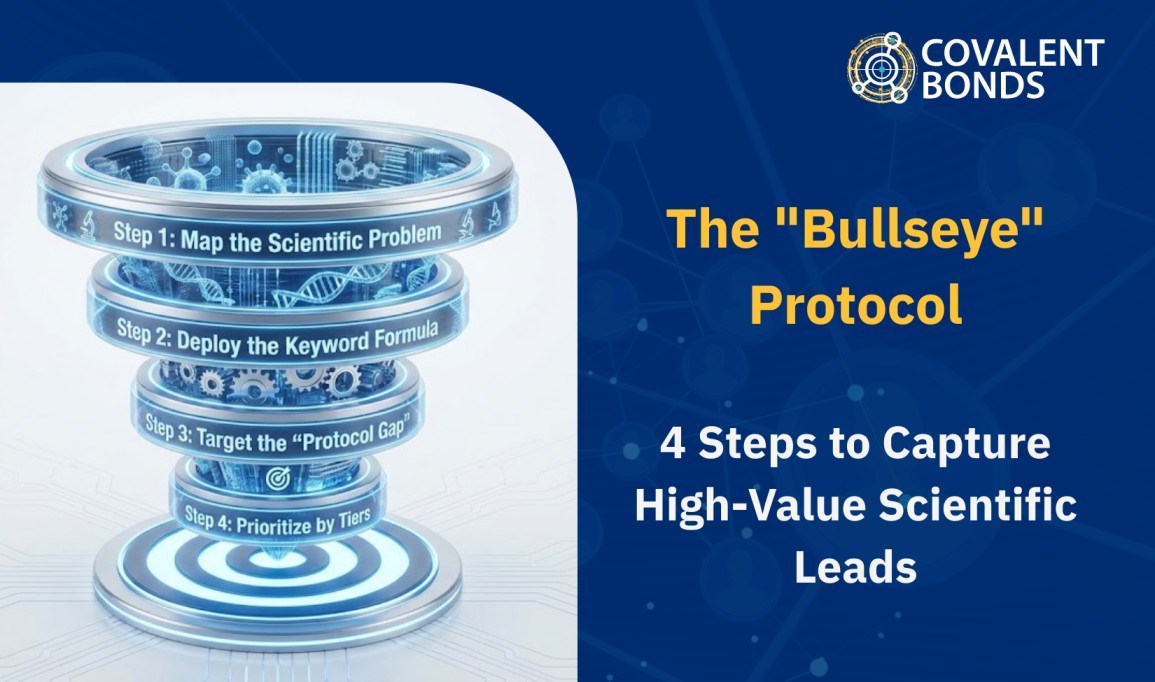
To accelerate high-quality lead generation, marketers must transition from "Search Engines" to "Answer Engines". This involves solving specific protocol bottlenecks through a 4-step "Bullseye" Protocol that maps technical workflows directly to commercial intent, ensuring your content is cited as the definitive solution to a researcher’s problem.
The 4-Step "Bullseye" Protocol
- Map the Scientific Problem: Identify the exact technical workflow (e.g., GLP-compliant method validation) rather than the generic product.
- Deploy the Keyword Formula: [Technical Workflow] + [Target Outcome/Constraint] + [Commercial Intent].
- Target the "Protocol Gap": Create content for the phrases scientists actually use, such as "low background noise IHC protocol for brain tissue."
- Prioritize by Tiers: Focus budget on Tier 1 "Bullseye" terms with immediate ROI, while using Tier 3 for long-term AI authority (AEO).
What is the "Zero-Volume" Trap in B2B Life Sciences Marketing?
The "Zero-Volume" Trap refers to high-value technical keywords that show no search volume in traditional SEO tools because they are only searched by a handful of high-level decision-makers. In B2B Life Sciences Marketing, a phrase searched by five Directors of Procurement at a major pharmaceutical firm can be worth millions in contract value.
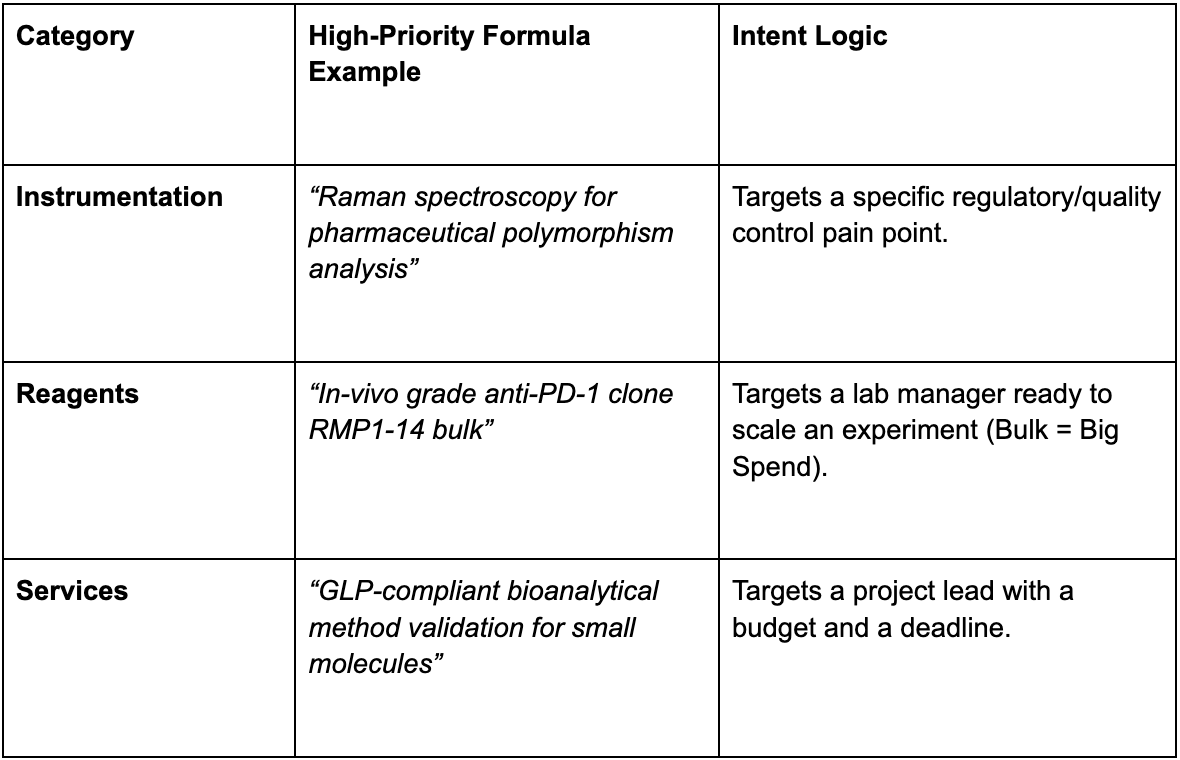
The Keyword Formula:
[Technical Workflow/Protocol] + [Target Outcome/Constraint] + [Commercial Intent]
The Competitive "Gap" Extraction
For established brands, the most profitable keywords often involve Comparison and Replacement intent.
- The "Alt" Strategy: Use tools to find keywords like “[Competitor Product Name] alternatives” or “[Competitor Product] vs [Your Product].”
- The "Protocol Gap": Scientists often search for “How to improve [Specific Process]” or “Troubleshooting [Scientific Step].” * Example: If you sell high-purity antibodies, target: "low background noise IHC protocol for brain tissue."
Quick Tip for The "Comparison" Battlefield in AI LLMs: Controlling the Narrative
On real-time AI engines like Perplexity, B2B buyers are aggressively cross-shopping. Data shows that Comparison Velocity is high; in many cases, nearly 70% of a brand's AI mentions are comparisons against competitors like Thermo Fisher or Eppendorf.
The Vulnerability: Top comparison topics are typically "Price" and "Product Features."
The Opportunity: If you don't produce content like "Company A vs. Company B: Why American Durability Wins," the AI will synthesize its own answer—often favoring the largest brand by default.
The Strategy: Feed the engines "tie-breaker" data—structured tables comparing technical specifications and specific value props—to ensure you win the automated recommendation.
Prioritization Matrix: The "Bullseye" Method
Stop trying to rank for everything. Prioritize based on this 2026 scoring system:

The 2026 "Zero-Volume" Trap
Many technical keywords in your niche show "Zero Search Volume" in traditional tools (SEMrush/Ahrefs).
Do not ignore them. In B2B Life Sciences, a keyword with "0 volume" that is searched by 5 Directors of Procurement at Pfizer is worth $1,000,000. Use Salesforce/CRM data and Sales Team Interviews to find the phrases customers actually use in meetings (e.g., "Is this instrument 21 CFR Part 11 compliant?").
Case Study: Reaching You (The "Bridge" Strategy)
We used this exact same methodology to reach you. Just as a scientist searches for a protocol fix, a frustrated life science marketer searches for a solution to their "Marketing Friction."
We identified that while "Marketing life sciences" has high volume (1,000+), it is full of academic noise. Instead, we targeted the "Bridge Keyword" where your technical niche meets your platform pain:
- The Marketer Example: "Life science PPC agency."
- The Intent Logic: This keyword has lower volume but 100% commercial intent. It bypasses the generalist agencies and reaches the person who needs a partner that understands both the science and the 2026 AI search landscape.
By applying the same "Surgical Strike" to our own PPC, we ensure we aren't just seen—we are cited as the definitive answer to your specific growth problem.
The AEO Knowledge Base: Frequently Asked Questions
Q: What is the most effective way to optimize life science content for AI search engines?
A: The most effective method is Answer-First structuring. Place a direct 40-60 word answer immediately following a technical H2 or H3 heading. This increases the probability of being cited as the "definitive source" by LLMs like ChatGPT and Perplexity.
Q: Why do traditional SEO tools show "Zero Volume" for high-value B2B life science keywords?
A: Traditional tools rely on broad consumer data. In scientific B2B, a keyword with "0 volume" might be searched by only 10 people—but if those 10 people are Procurement Directors at Pfizer, the keyword is worth millions. Use CRM data and sales interviews to identify these high-intent phrases.
Q: How can a life science PPC agency help improve lead quality over a generalist agency?
A: A specialized life science PPC agency uses "Surgical Strike" targeting to exclude academic and student traffic. By bidding on "Bridge Keywords" that combine technical workflows with commercial intent, they reduce wasted spend on non-buying researchers.


